Travel — St. Elmo’s Fire
Where Was St. Elmo’s Fire Filmed? Georgetown Said No, Maryland Said Yes
November 29, 2026
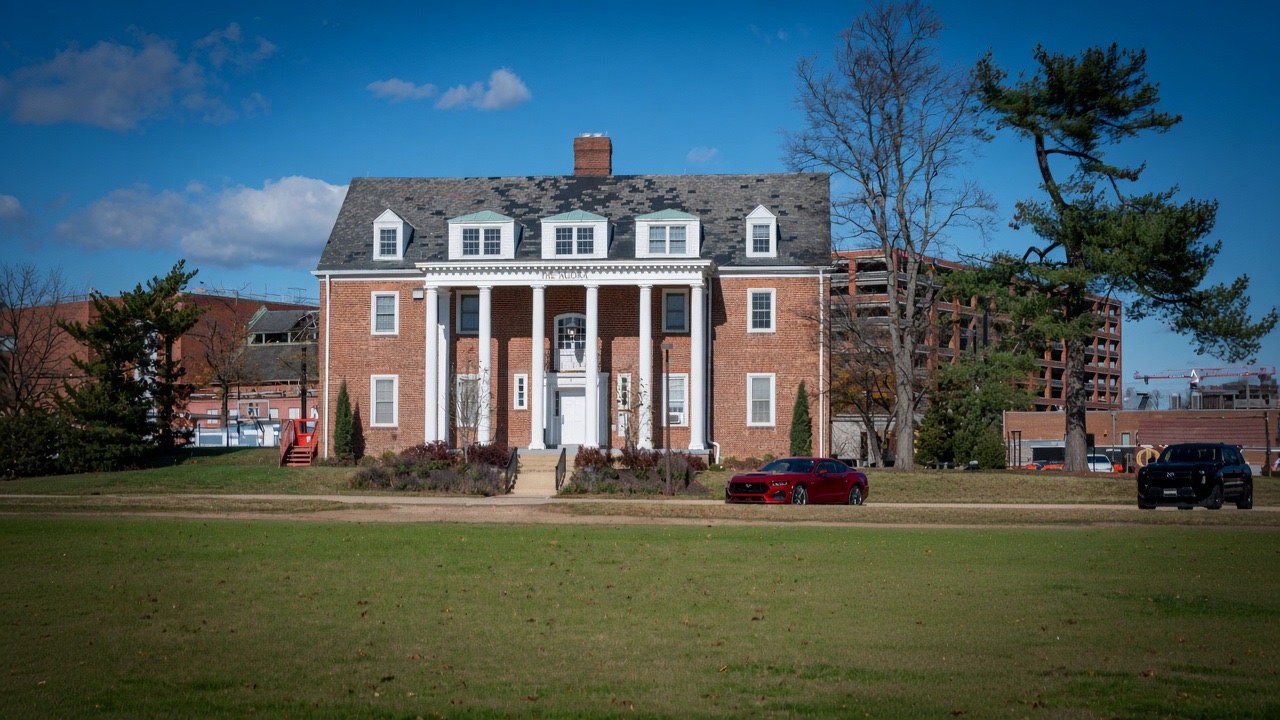
Georgetown read the script and said no. So the Brat Pack graduated ten miles away, on a fraternity lawn in Maryland.

The most famous shot in St. Elmo’s Fire lasts about ten seconds. Seven young graduates in caps and gowns, arms linked, walking toward the camera across a college lawn while the credits roll. It opens the film, and it tells you everything the movie wants you to believe: these seven grew up together here, and this place made them who they are.
The official trailer for the 40th anniversary 4K restoration — the graduation walk opens it. Video: Sony Pictures Entertainment.
The place in the shot never taught a single one of them. The school in the story is Georgetown University. The lawn in the shot belongs to the University of Maryland, ten miles away in College Park. Georgetown read the script and said no.
Joel Schumacher, who co-wrote and directed the film with Carl Kurlander, went to Washington to scout locations and sat down with Georgetown’s vice provost, J. Donald Freeze. Freeze had read the script. The premarital sex, the drug use, the rest of it — none of it sat right with a Jesuit university, and he turned the production away. The only glimpse of Georgetown in the finished film is a long shot taken from across the Potomac River.
Here is the part that stings, if you know the neighbourhood. Georgetown had already let Hollywood in once. A dozen years earlier, The Exorcist filmed on the same streets — the steps at 36th and Prospect, the house at 3600 Prospect Street, the whole dark business of it. The university that opened its gates to a story about demonic possession drew the line at seven graduates figuring out their twenties. One film got the campus. The other got the door.
The Deal on Fraternity Row
So the production went ten miles northeast, to College Park, and knocked on a different door. The University of Maryland’s Fraternity Row sits just off Baltimore Avenue, a run of red brick houses with white columns that could pass for Georgetown at a glance, and the people who ran it were students. The Interfraternity Council co-managed the row with the school, and its board struck a deal: the film could use the houses and the lawn, as long as the fraternity brothers got to be in it. About fifty of them were hired as extras.
The crew was there for two days in October 1984. Maryland made the final cut in exactly three scenes. The opening graduation walk, with the Sigma Kappa sorority house standing in for an academic building behind the cast. A football scene on the field in the horseshoe. And a quiet chat between Rob Lowe’s Billy and his wife, with Memorial Chapel standing white and plain in the background.
The students who were there still tell the stories forty years on. Jay Hergenroeder, class of ’86, was plucked out of the extras by Schumacher himself to greet Lowe as Billy walked back into his old fraternity house. Howard Schacter, a Phi Sigma Delta brother at 14 Fraternity Row, spent a day and a half next to Lowe doing more than thirty takes of running and throwing a football, and watched one of his fraternity brothers step into a shower and find himself standing next to Andrew McCarthy. Demi Moore caught a brother staring down from a fraternity roof and mooned him. When the film played its sold-out first screening at the campus Hoff Theater, Hergenroeder’s brother stood up in the back and yelled, “There’s Birdog!” — his family nickname. Lisa Claps Usher skipped class that day and came home with a photograph of herself beside McCarthy. Lowe, the heartthrob of the moment, was spotted in a station wagon by students who mobbed the car “like the Beatles,” rocking it back and forth.
Walk the row today and the trick still works. The houses look the way they looked in 1984 — brick, columns, wide lawns — and the opening shot is easy to find. Every year, graduating seniors re-enact it in front of the Sigma Kappa house, caps and gowns and arms linked, the same ten seconds, forty years on.
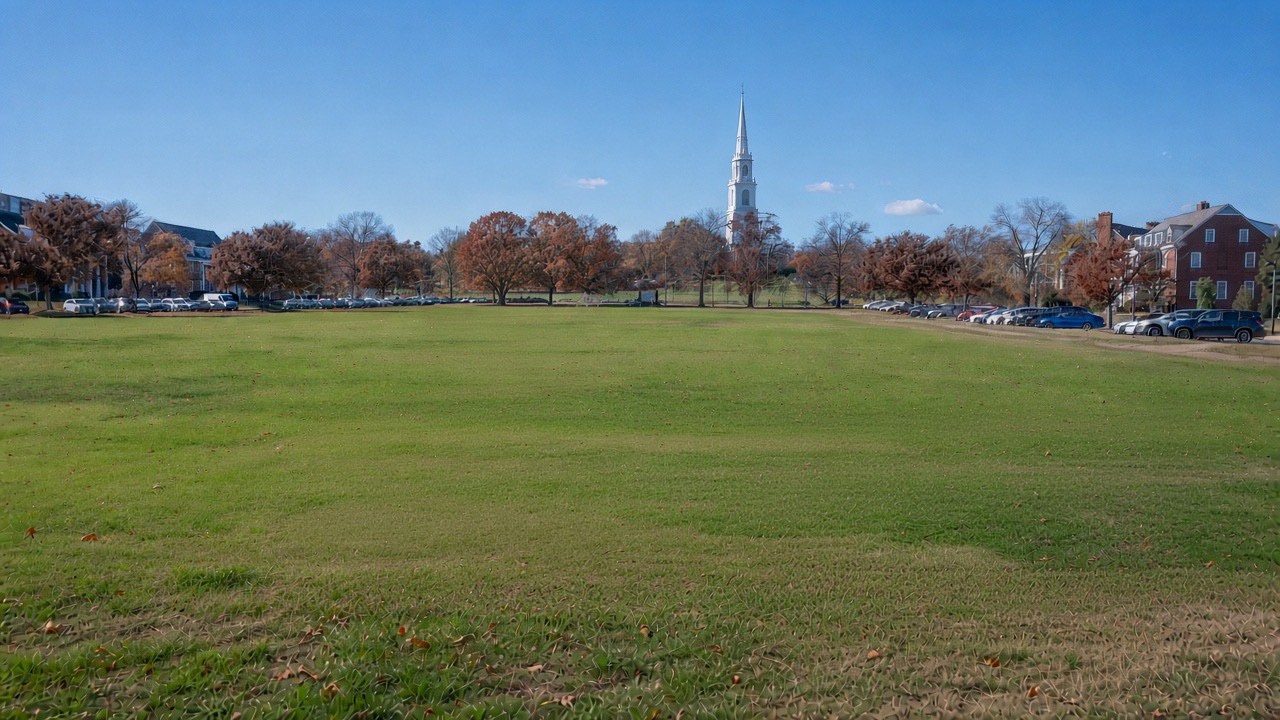
Across the big green of McKeldin Mall, Memorial Chapel rises white against the sky, the same steeple that stood behind Billy and his wife. Stand on the mall and the campus gives you the film’s quietest image for free.
This paper walked all of it. The row, the mall, the corner at 36th and Prospect, and the stairs down into The Tombs itself.
The Bar That Never Was
The bar, though, was never a place you could walk into. St. Elmo’s Bar is a composite, built from three pieces. The look came from The Tombs, the below-ground rathskeller at 1226 36th Street NW in Georgetown, opened in 1962 beneath the restaurant 1789 and bought by Clyde’s Restaurant Group in 1985. The exterior most guides point to is the Third Edition, a couple of blocks east at 1218 Wisconsin Avenue and M Street, long since closed. The interiors were built on a Hollywood soundstage.
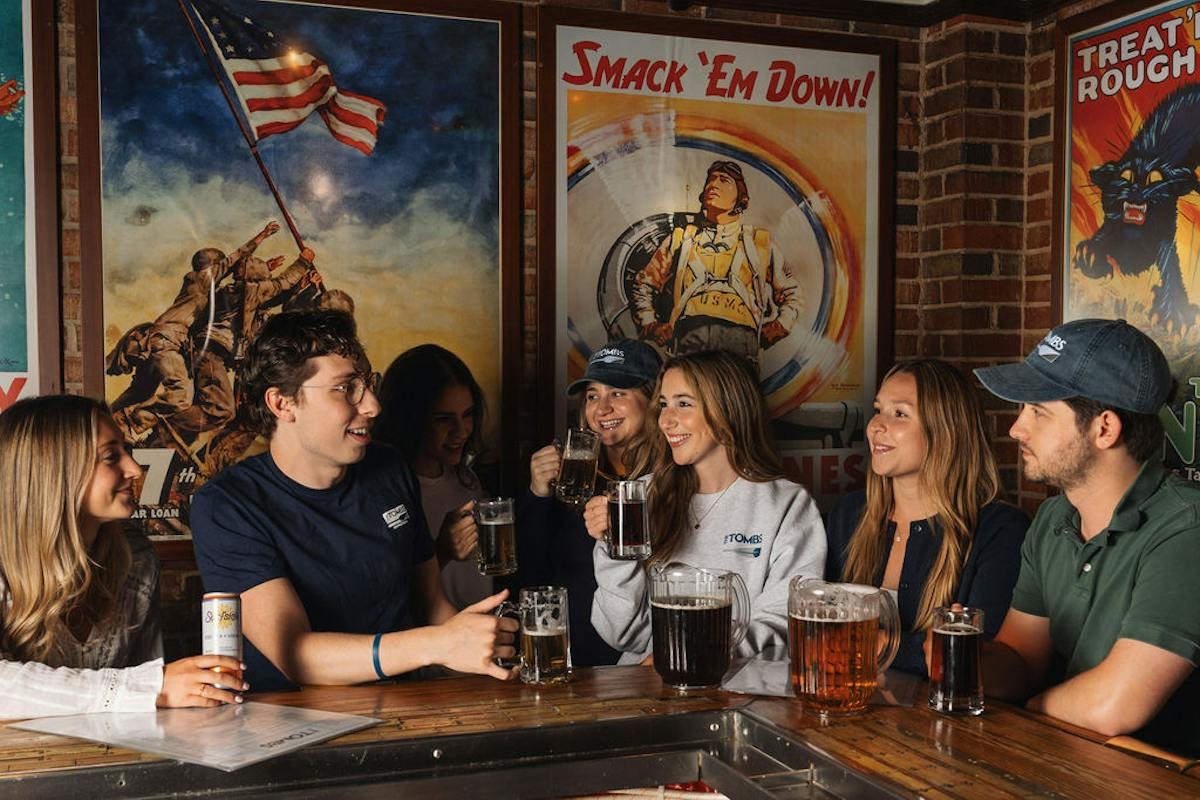
The Tombs is worth the trip on its own, and it sits on the same corner as the other film. Stand at 36th and Prospect and the Exorcist house is right across the street. The Tombs even has its own Exorcist connection: the dinner scene where Father Karras tells a fellow priest he may be losing his faith was filmed inside it. Two films, one corner, and a bar that only ever existed in pieces.
The Film Itself
So what about the film itself? The critics hated it. David Denby called Schumacher “brutally untalented.” Rotten Tomatoes has it at 44 percent. Rob Lowe took home a Razzie for Worst Supporting Actor. Audiences disagreed: thirty-seven point eight million dollars on a ten million dollar budget, the twenty-third biggest film of 1985, and a term the culture still uses. The phrase “Brat Pack” was coined by writer David Blum after he met the cast on the occasion of this film’s release. The Breakfast Club had come out a few months earlier, and the same young actors kept showing up together — Estevez, Nelson, Sheedy, Lowe, Moore, McCarthy, Winningham — until the label stuck to all of them.
The music outlasted the reviews. David Foster, a Canadian, wrote his first film soundtrack here, and the title song became the bigger hit. John Parr’s “St. Elmo’s Fire (Man in Motion)” spent two weeks at number one on the Billboard Hot 100 in August 1985. Parr and Foster wrote it in a single afternoon, and Parr had never even seen the film. Foster showed him a news clip about Rick Hansen, the Canadian athlete wheeling around the world to raise money and awareness for spinal cord research, on a journey Hansen called the Man in Motion Tour. Parr wrote about that instead. The song belongs to a Canadian in a wheelchair, not to seven Georgetown graduates, and it still lifts the film every time it plays.
Forty years on, the film is a time capsule more than a drama. The crimped hair and shoulder pads, the sax solos, the seven beautiful people making every wrong choice in the book — none of it holds up as realism, and all of it holds up as a record of what 1985 felt like to be twenty-two. The critics were right about the dialogue and wrong about the staying power. You can argue with the film. You can’t argue with the lawn.
Georgetown still won’t show you where it was filmed, because it wasn’t filmed there. Drive ten miles to College Park instead. The row is open, the mall is open, the chapel is still standing, and the graduates still come back every spring to walk the same ten seconds. The school that said no gave the film its best story. The school that said yes gave it its opening shot.
Sources: Maryland Today and Terp magazine, University of Maryland; Hyattsville Wire; Wikipedia; Stereogum; The Tombs, tombs.com. The Tombs photo is courtesy of The Tombs; the other two photos by Franklin McKay.
St. Elmo’s Fire — directed by Joel Schumacher, written by Joel Schumacher and Carl Kurlander (1985). Photographs by Franklin McKay, except the Tombs photo, courtesy of The Tombs.
the daily · franklin mckay